Mera Peak Climbing: 10 Common Mistakes First-Time Climbers Make (and How to Avoid Them)

Mera Peak climbing is often described as one of the most achievable 6,000-meter mountaineering objectives in Nepal. Standing at 6,476 meters, Mera Peak attracts trekkers and aspiring climbers from around the world who want to experience high-altitude mountaineering without extreme technical difficulty. However, while the climb is considered non-technical, it should never be underestimated.

In fact, many first-time climbers make avoidable mistakes that can turn a rewarding adventure into a challenging or even dangerous experience. Therefore, understanding the most common Mera Peak climbing mistakes—and learning how to avoid them—is essential for a safe, successful, and enjoyable ascent.

This detailed guide highlights the 10 most common mistakes first-time climbers make on Mera Peak and provides practical, experience-based solutions. Moreover, the article is designed to help you prepare smarter, acclimatize better, and climb more confidently, whether you are planning a guided or private expedition.


Mistake 1: Underestimating Mera Peak Climbing Difficulty

One of the most frequent Mera Peak climbing mistakes is assuming that the climb is easy simply because it is labeled as “non-technical.” While it is true that Mera Peak does not require advanced rock or ice climbing skills, the altitude alone presents serious challenges.

At nearly 6,500 meters, oxygen levels are significantly reduced. Consequently, even basic movements become physically demanding. Additionally, summit day can last 10–12 hours in cold, windy conditions.

How to avoid this mistake:

First and foremost, treat Mera Peak as a high-altitude mountaineering expedition, not just a trek. Train accordingly, both physically and mentally. Furthermore, respect the mountain by allowing adequate time for acclimatization and recovery.


Mistake 2: Poor Acclimatization Planning

Inadequate acclimatization is one of the leading causes of failed Mera Peak climbs. Many first-time climbers rush the itinerary in an attempt to save time or reduce costs. As a result, they expose themselves to altitude sickness, exhaustion, or forced descent.

Proper acclimatization allows your body to adjust gradually to reduced oxygen levels. Without it, symptoms such as headaches, nausea, dizziness, and loss of appetite can escalate quickly.

How to avoid this mistake:

Choose an itinerary that includes multiple acclimatization days, particularly above 4,500 meters. Additionally, follow the principle of “climb high, sleep low” whenever possible. Most importantly, listen to your body and communicate symptoms early.


Mistake 3: Insufficient Physical Preparation

Another common mistake in Mera Peak climbing is inadequate physical training before the expedition. Although the climb does not involve technical rock climbing, it demands sustained endurance, leg strength, and cardiovascular fitness.

Long trekking days, heavy boots, crampons, and cold temperatures can quickly overwhelm climbers who are not properly conditioned.

How to avoid this mistake:

Begin training at least three to four months before your climb. Focus on aerobic activities such as hiking, running, cycling, and stair climbing. In addition, incorporate strength training for legs, core, and back. If possible, practice hiking with a loaded backpack to simulate real conditions.


Mistake 4: Choosing the Wrong Season for Mera Peak Climbing

Timing plays a crucial role in the success of any Himalayan expedition. Some first-time climbers choose unsuitable seasons, assuming that Mera Peak is climbable year-round. Unfortunately, this can lead to poor weather, limited visibility, and unsafe conditions.

The best seasons for Mera Peak climbing are spring (March to May) and autumn (September to November). During these periods, weather conditions are generally more stable, and temperatures are manageable.

How to avoid this mistake:

Plan your climb during the recommended seasons. Moreover, monitor weather forecasts closely and allow flexibility in your itinerary for unexpected delays.


Mistake 5: Inadequate Gear and Equipment

Improper or low-quality gear is a significant contributor to discomfort and failure on Mera Peak. First-time climbers often underestimate the cold or rely on unsuitable trekking equipment.

Essential items such as insulated boots, proper down jackets, sleeping bags, and mountaineering hardware are critical for safety at high altitude.

How to avoid this mistake:

Invest in high-quality, tested mountaineering gear. Alternatively, rent equipment in Kathmandu from reputable suppliers. Additionally, ensure that all gear is properly fitted and tested before the climb.


Mistake 6: Ignoring Nutrition and Hydration

At high altitude, appetite often decreases, yet the body requires more energy than usual. Many climbers fail to eat and drink enough during the trek and summit push, leading to fatigue and poor performance.

Dehydration, in particular, can worsen altitude sickness symptoms and reduce overall stamina.

How to avoid this mistake:

Make a conscious effort to eat balanced meals rich in carbohydrates. Furthermore, drink at least 3–4 liters of fluid per day. Warm drinks, soups, and electrolyte solutions are especially beneficial in cold conditions.


Mistake 7: Lack of Basic Mountaineering Skills

Although Mera Peak is considered an introductory mountaineering peak, it still requires fundamental skills such as using crampons, walking with an ice axe, and moving safely on glaciers.

First-time climbers sometimes rely entirely on guides without understanding basic techniques. Consequently, this increases risk during summit day and glacier crossings.

How to avoid this mistake:

Choose an expedition that includes pre-climb training at base camp. Learn essential skills such as rope travel, ladder crossing, and self-arrest. Even basic familiarity can significantly improve confidence and safety.


Mistake 8: Overpacking or Under-packing

Packing mistakes are surprisingly common on Mera Peak expeditions. Some climbers carry excessive gear, making trekking days unnecessarily exhausting. Others bring too little, leaving them unprepared for extreme cold or emergencies.

How to avoid this mistake:

Follow a detailed Mera Peak packing list provided by experienced operators. Pack efficiently, focusing on layered clothing and multipurpose items. Additionally, ensure porters are not overloaded beyond ethical limits.


Mistake 9: Choosing the Cheapest Operator Without Research

Cost is an important factor, but selecting the cheapest Mera Peak climbing package without proper research can lead to compromised safety, poor logistics, and inexperienced staff.

Low-cost operators may cut corners on acclimatization days, guide experience, or emergency preparedness.

How to avoid this mistake:

Research operators thoroughly. Look for licensed companies with experienced guides, positive reviews, and transparent itineraries. Furthermore, confirm that emergency protocols and insurance coverage are included.


Mistake 10: Ignoring Early Warning Signs

Perhaps the most dangerous mistake first-time climbers make is ignoring symptoms of altitude sickness or extreme fatigue. Pushing through severe symptoms can result in serious medical emergencies.

How to avoid this mistake:

Always prioritize health over the summit. Inform your guide immediately if you experience persistent headaches, nausea, confusion, or breathing difficulties. Remember, a successful Mera Peak climb is one where everyone returns safely.


Final Thoughts: Climb Smarter, Not Harder

Mera Peak climbing offers an incredible opportunity to experience Himalayan mountaineering while enjoying breathtaking views of Everest, Makalu, and Kanchenjunga. However, success depends largely on preparation, awareness, and decision-making.

By understanding these common Mera Peak climbing mistakes and applying the recommended solutions, first-time climbers can significantly improve their chances of a safe and rewarding ascent. Ultimately, patience, preparation, and respect for the mountain are the true keys to standing on the summit of Mera Peak.

With the right mindset and planning, your first Mera Peak climbing experience can become a lifelong memory—and a strong foundation for future high-altitude adventures.

Solo Female Travel to Mera Peak: The Ultimate Independent Climber’s Guide to Nepal’s Highest Trekking Peak

Mera Peak (6,476 m) is Nepal’s highest trekking peak and one of the most achievable 6,000-meter summits in the Himalayas. For solo female travelers seeking a high-altitude mountaineering challenge without extreme technical difficulty, Mera Peak offers a rare combination of safety, solitude, breathtaking scenery, and personal empowerment.

In recent years, Nepal has become increasingly welcoming to solo female trekkers and climbers. With proper planning, cultural awareness, and a reliable support structure on the ground, solo female travel to Mera Peak is not only possible but deeply rewarding. This guide is designed specifically for independent female climbers—covering safety, logistics, training, permits, costs, accommodation, and practical tips to help you climb with confidence.


Why Mera Peak Is Ideal for Solo Female Climbers

Mera Peak is often recommended as a first Himalayan summit for several reasons:

  • Non-technical ascent: No advanced climbing skills are required, only basic mountaineering techniques.
  • Well-established route: The trail is clear, and lodges are available up to Khare.
  • Supportive climbing culture: Nepali guides and porters are accustomed to working with solo female clients.
  • Lower objective risk: Compared to peaks like Island Peak or Lobuche East, Mera Peak has fewer exposed sections.

For women seeking independence without unnecessary risk, Mera Peak strikes an excellent balance between challenge and safety.


Is Solo Female Travel to Mera Peak Safe?

Safety is the most common concern—and rightly so. The good news is that Nepal is one of the safest destinations in Asia for solo female travelers, particularly in trekking regions.

Key Safety Factors

  • Local hospitality: Sherpa and Rai communities along the Mera route are respectful and welcoming.
  • Low crime rate: Violent crime against trekkers is extremely rare.
  • Teahouse culture: Staying in lodges provides social interaction and security.
  • Mandatory local support: While you can travel independently, climbing Mera Peak requires a licensed guide by regulation.

Practical Safety Tips

  • Choose a registered trekking agency with experience handling solo female climbers.
  • Request a female guide or assistant guide if that makes you more comfortable (available on request).
  • Avoid trekking after dark.
  • Carry a satellite communication device or ensure your guide has one.

With common-sense precautions, solo female climbers regularly complete Mera Peak without incident.


Permits and Regulations for Mera Peak

Climbing Mera Peak requires multiple permits, all of which can be arranged through a local agency.

Required Permits

  1. Mera Peak Climbing Permit
    • Spring & Autumn: USD 250
    • Summer: USD 125
    • Winter: USD 70
  2. Makalu Barun National Park Permit
    • Approx. USD 30
  3. Local Area Permit (Khumbu/Makalu region)

As an independent climber, you cannot apply for the climbing permit alone—it must be processed through a Nepal government-licensed trekking agency.


Best Time for Solo Female Travel to Mera Peak

Choosing the right season significantly impacts safety, comfort, and success.

Best Seasons

  • Spring (April–May): Stable weather, warmer temperatures, busy but social trails.
  • Autumn (October–November): Clear skies, colder nights, excellent summit views.

Off-Season Considerations

  • Winter (December–February): Very cold, fewer climbers, increased risk.
  • Monsoon (June–September): Poor visibility, flight delays, higher landslide risk.

For solo female climbers, spring and autumn are strongly recommended due to better infrastructure, weather, and trail activity.


Physical Preparation and Training for Women

Mera Peak is not technically difficult, but it is physically demanding due to altitude and duration.

Fitness Requirements

  • Ability to trek 6–8 hours per day for multiple consecutive days
  • Strong cardiovascular endurance
  • Mental resilience for cold and fatigue

Recommended Training Plan (3–4 Months)

  • Hiking with a weighted backpack
  • Stair climbing or hill repeats
  • Strength training (legs, core)
  • Endurance cardio (cycling, running, swimming)

Prior high-altitude experience is helpful but not mandatory if acclimatization is done properly.


What to Pack as a Solo Female Climber

Packing correctly is essential, especially when traveling independently.

Essential Clothing

  • Layered system (base, mid, insulation, shell)
  • Down jacket rated to –20°C
  • Thermal underwear
  • Insulated gloves and mittens
  • Women-specific mountaineering boots (double boots recommended)

Personal Items

  • Female hygiene products (limited availability on trail)
  • Menstrual cup or reusable options (eco-friendly)
  • Personal medications
  • Sunscreen and lip balm (high SPF)

Climbing Gear

Most technical equipment (crampons, ice axe, harness) can be rented in Kathmandu, reducing luggage weight.


Accommodation on the Mera Peak Route

Teahouses and Lodges

  • Available up to Khare (4,900 m)
  • Private rooms often available early in the season
  • Shared dining areas create a safe social environment

High Camp

  • Tent accommodation arranged by your guide
  • Separate sleeping arrangements can be requested

As a solo female traveler, you will rarely be completely isolated—most nights are spent around other trekkers and staff.


Cultural Awareness and Respect

Understanding local customs not only improves your overall travel experience but also plays a crucial role in personal safety. First of all, dressing modestly in villages by covering your shoulders and legs shows respect for local traditions. In addition, asking for permission before taking photos of local people helps build trust and avoids misunderstandings. At the same time, it is important to avoid public displays of affection, as mountain communities tend to be culturally conservative. Furthermore, if you ever feel uncomfortable, you should remain polite while firmly setting clear personal boundaries. Ultimately, Nepali mountain communities are conservative yet respectful, and therefore, solo female travelers are widely accepted and welcomed throughout the region.


Costs for Solo Female Travel to Mera Peak

While group climbs are cheaper, solo travel offers flexibility and personal pacing.

Estimated Cost Breakdown

  • Guided Mera Peak climb (solo): USD 2,500–3,500
  • Gear rental: USD 150–300
  • Flights (Kathmandu–Lukla): USD 350–450
  • Tips (guide & porter): USD 150–250

For this reason, solo climbers generally pay more due to private logistics. Nevertheless, many climbers still view the investment as worthwhile, since it provides increased independence and overall comfort.


Mental Strength and Confidence

Climbing Mera Peak solo is as much a mental journey as a physical one. Many women describe the experience as transformative—building confidence, resilience, and self-trust.

Moments of doubt are normal, especially at altitude. Having a supportive guide, realistic expectations, and strong motivation makes all the difference.


Final Thoughts: Is Mera Peak Worth It for Solo Female Travelers?

Absolutely.

Solo female travel to Mera Peak is one of the most empowering Himalayan experiences available today. With proper preparation, reliable local support, and respect for the mountain environment, independent female climbers can safely and successfully reach the summit of Nepal’s highest trekking peak.

Mera Peak is not just a climb—it is a statement of independence, strength, and capability. For women seeking adventure beyond conventional trekking, it remains one of Nepal’s finest and most achievable high-altitude goals.

Private vs Group Climbing on Island and Mera Peak: A Complete Comparison Guide

Climbing Island Peak (6,189m) and Mera Peak (6,476m) are among Nepal’s most popular Himalayan adventures for aspiring mountaineers. However, one of the most critical decisions climbers must make before booking is whether to join a private climbing expedition or a group climbing trip.

While both options ultimately lead you to the summit, the experience, cost, flexibility, safety, and success rate can differ significantly. Therefore, understanding the differences between private vs group climbing on Island Peak and Mera Peak is essential for choosing the right expedition style.

This complete comparison guide breaks down every key factor to help you make an informed decision.


Overview of Island Peak and Mera Peak Climbing

Before comparing private and group expeditions, it is important to understand the nature of these two iconic peaks.

Island Peak (Imja Tse)

Island Peak is technically more demanding, involving:

  • Glacier travel
  • Fixed ropes
  • Steep snow and ice sections
  • Basic mountaineering skills

It is often combined with the Everest Base Camp trek, making it popular among trekkers looking to advance into alpine climbing.

Mera Peak

Mera Peak, although higher, is considered less technical. However, it requires:

  • Excellent endurance
  • High-altitude acclimatization
  • Long summit day (10–12 hours)

Because of its altitude, Mera Peak is ideal for climbers seeking their first 6,000m+ Himalayan summit.


What Is Private Climbing on Island and Mera Peak?

A private climbing expedition is fully customized and organized exclusively for you or your chosen group (friends, family, or colleagues). No other climbers are added unless requested.

Key Characteristics of Private Climbing

  • Flexible itinerary and dates
  • Personalized pace and acclimatization
  • Dedicated guides and support staff
  • Customized safety and logistics
  • Higher summit success rate

Private trips are particularly suitable for climbers with specific goals, limited time, or prior mountaineering experience.


What Is Group Climbing on Island and Mera Peak?

A group climbing expedition involves joining other climbers, usually with fixed departure dates and a shared itinerary.

Key Characteristics of Group Climbing

  • Pre-set schedule and route
  • Shared guides and resources
  • Lower overall cost
  • Social and team-based experience
  • Fixed acclimatization plan

Group climbing is popular among solo travelers, first-time climbers, and those on a budget.


Private vs Group Climbing: Detailed Comparison

Cost Comparison

Group Climbing

  • More affordable due to shared costs
  • Fixed pricing per person
  • Limited customization

Private Climbing

  • Higher upfront cost
  • Cost-effective for 2–4 climbers
  • Better value for personalized service

Verdict:
Group climbing is budget-friendly, while private climbing offers higher value through customization and safety.


Flexibility and Itinerary Control

Flexibility is one of the most significant differences between private and group climbing.

Private Expedition

  • Adjust trekking pace
  • Add extra acclimatization days
  • Delay summit attempt due to weather
  • Choose alternative routes or rest days

Group Expedition

  • Fixed daily schedule
  • Limited flexibility
  • Decisions based on group consensus

Verdict:
Private climbing clearly wins in flexibility, which is crucial for high-altitude success.


Safety and Acclimatization

High altitude poses serious risks, including AMS, HAPE, and HACE. Therefore, acclimatization strategy matters greatly.

Private Climbing

  • Individual health monitoring
  • Custom acclimatization plan
  • Immediate decision-making by guide
  • Higher safety margins

Group Climbing

  • Standard acclimatization schedule
  • Less individual attention
  • Group decisions may delay descent

Verdict:
Private climbing offers superior safety, especially for climbers new to altitude.


Guide-to-Climber Ratio

Private Trips

  • 1:1 or 1:2 guide-to-climber ratio
  • Dedicated climbing Sherpa
  • Continuous technical assistance

Group Trips

  • 1 guide for 4–6 climbers
  • Shared climbing Sherpas
  • Less personalized coaching

Verdict:
For technical sections on Island Peak and long summit days on Mera Peak, private climbing provides a clear advantage.


Summit Success Rate

Although no summit is guaranteed, success rates differ.

Private Climbing

  • Better pacing
  • More acclimatization options
  • Flexible summit window
  • Higher overall success rate

Group Climbing

  • Summit attempt depends on group readiness
  • Fixed summit date
  • Lower flexibility during bad weather

Verdict:
Private expeditions generally achieve higher summit success rates.


Experience Level Suitability

Best for Private Climbing

  • Intermediate to experienced climbers
  • Trekkers upgrading to alpine climbing
  • Those with limited holiday time
  • Climbers prioritizing safety and success

Best for Group Climbing

  • First-time Himalayan climbers
  • Budget travelers
  • Solo adventurers
  • Those who enjoy team dynamics

Social Experience and Team Dynamics

Group Climbing

  • International camaraderie
  • Shared challenges and bonding
  • Ideal for solo travelers

Private Climbing

  • More focused and quiet experience
  • Best for couples or close-knit teams
  • Less social interaction

Verdict:
Group climbing excels socially, while private climbing offers a more focused summit-oriented experience.


Which Option Is Better for Island Peak?

Island Peak involves technical climbing elements such as:

  • Fixed ropes
  • Ice walls
  • Crevasse crossings

Recommended Option:
👉 Private climbing is strongly recommended, especially for climbers with limited technical experience or those prioritizing safety.


Which Option Is Better for Mera Peak?

Mera Peak requires endurance rather than technical skills.

Recommended Option:
👉 Both options work well, but private climbing is ideal for those concerned about altitude or seeking a flexible summit window.


Private vs Group Climbing: Quick Comparison Table

FactorPrivate ClimbingGroup Climbing
CostHigherLower
FlexibilityVery HighLimited
SafetyExcellentModerate
Summit SuccessHigherVariable
Social ExperienceLimitedHigh
CustomizationFullMinimal

Final Verdict: Private or Group Climbing?

Choosing between private vs group climbing on Island Peak and Mera Peak ultimately depends on your priorities.

  • Choose private climbing if you value safety, flexibility, personalized support, and summit success.
  • Choose group climbing if you prefer affordability, social interaction, and a fixed itinerary.

Both options offer unforgettable Himalayan experiences. However, for climbers seeking a higher chance of success and a tailored journey, private expeditions remain the superior choice.

Mera Peak for Beginners in 2026/27: Difficulty, Training, and Success Tips

Mera Peak is one of Nepal’s most iconic trekking peaks. Each year, climbers from around the world attempt it. Many wonder: Can beginners climb Mera Peak successfully? The short answer is yes — but only with the right preparation, training, acclimatization strategies, and logistical planning. In this guide, we will cover all aspects of Mera Peak for beginners in 2026/27, including difficulty, training tips, equipment lists, acclimatization schedules, and success strategies.

Mera Peak stands at 6,476 meters (21,247 feet) above sea level. It is classified as a trekking peak by the Nepal Mountaineering Association (NMA). For many climbers, especially those new to high‐altitude mountaineering, Mera Peak represents both a challenge and a realistic first summit.

This article aims to answer your most important questions:

  • What is the difficulty level of Mera Peak for beginners?
  • How should you train?
  • What should you expect on the route?
  • How can you maximize your chance of success in 2026?

What Makes Mera Peak Ideal for Beginners?

Trekking Peak Classification

Mera Peak is a part of the NMA’s trekking peak category. These peaks are considered more achievable for climbers without prior expedition experience. They often require:

  • Moderate technical climbing skills
  • Rope techniques
  • Fixed line navigation
  • Glacier travel

However, they do not normally demand advanced skills like ice climbing steep walls or complex glacier navigation found on higher mountaineering objectives.

This accessibility makes Mera Peak for beginners in 2026/27 a realistic goal, provided you prepare thoroughly.

Spectacular Himalayan Scenery

The route to Mera Peak offers incredible views. Climbers see five of the world’s 14 highest mountains, including Mount Everest, Lhotse, Makalu, Cho Oyu, and Kangchenjunga. These views are motivating and add to the overall experience.

Gradual Altitude Gain

The Mera Peak itinerary generally includes gradual altitude gain. This is vital for:

  • Proper acclimatization
  • Minimizing altitude sickness
  • Increasing your chance of summit success

The standard trek starts in Lukla and progresses through traditional Sherpa villages and high alpine landscapes before moving onto glacier and ice terrain near the summit.


Understanding the Difficulty of Mera Peak

To realistically assess Mera Peak for beginners in 2026/27, you must understand the challenges involved.

Altitude and Acclimatization

Mera Peak’s altitude (6,476 m) places it firmly in the high‐altitude category. At these heights, oxygen levels are significantly lower than at sea level. Common effects include:

  • Headaches
  • Nausea
  • Fatigue
  • Shortness of breath

Proper acclimatization is not optional — it is essential. A structured acclimatization schedule drastically improves your chance of summit success and safety.

Glacier and Snow Travel

While Mera Peak does not require highly technical ice climbing, the final ascent involves:

  • Glacier crossings
  • Snow slopes up to 40–45 degrees
  • Use of crampons and ice axes

Beginners will need training in:

  • Walking on snow and ice
  • Using crampons
  • Self‐arrest techniques with an ice axe

Basic Rope Skills

You must be comfortable with:

  • Walking on fixed rope sections
  • Using a harness
  • Applying ascenders (jumars)
  • Descending with belay devices

These skills are standard for many trekking peaks and are usually taught by guide teams before the climb.


Training Program for “Mera Peak for Beginners in 2026/27”

To succeed on Mera Peak, consistent and structured training is crucial. Your training program should begin at least 12 to 16 weeks before departure.

Cardiovascular Conditioning

Mera Peak demands high endurance. Cardiovascular training enhances:

  • Lung capacity
  • Heart efficiency
  • Fatigue resistance

Recommended activities:

  • Long-distance hiking with a loaded backpack
  • Stair climbing with weighted pack
  • Cycling
  • Running (especially hills or intervals)

A target training goal:

  • 4–6 days per week
  • Sessions between 60–120 minutes

Strength Training

You should focus on muscles used during climbing:

  • Quadriceps
  • Hamstrings
  • Glutes
  • Core muscles
  • Shoulders and upper back

Sample strength exercises:

  • Squats and lunges (weighted)
  • Step-ups
  • Deadlifts
  • Planks and core work

Perform strength training at least 2–3 times per week.

Technical Climbing Skills

A beginner should learn and practice:

  • Ice axe self-arrest
  • Crampon walking
  • Fixed line climbing
  • Rope handling skills

Enroll in a basic mountaineering course if possible. Many outdoor schools offer weekend clinics that cover all essential techniques.

High-Altitude Simulation

If you live at low altitude, consider:

  • Hiking at higher elevations during training
  • Using altitude simulation devices or masks (note: these are aids but not substitutes for acclimatization)

Training at altitude helps your body adapt sooner.


Typical Itinerary for Mera Peak in 2026/27

Although itineraries vary by operator, a standard trekking and climbing schedule lasts 18–23 days.

Example itinerary highlights:

  1. Arrival in Kathmandu
  2. Fly to Lukla
  3. Trek through villages to Khare
  4. Acclimatization hikes
  5. Move up to High Camp
  6. Summit attempt
  7. Return trek and departure

Strategic rest days and acclimatization hikes are built in to:

  • Reduce the risk of altitude sickness
  • Improve physical adaptation
  • Build confidence before moving higher

Essential Gear for Mera Peak Climbers

Your gear list should balance weight with performance. Below is a recommended breakdown:

Clothing

  • Insulated mountaineering jacket
  • Base layers (moisture-wicking)
  • Softshell pants
  • Down pants for high camp
  • Thermal underwear
  • Lightweight trekking shirts

Footwear

  • Mountaineering boots (double boots recommended)
  • Gaiters
  • Wool trekking socks

Technical Gear

  • Crampons compatible with boots
  • Ice axe
  • Climbing harness
  • Helmet
  • Carabiners and personal hardware

Camping and Trekking

  • Sleeping bag (rated to at least -20°C)
  • Trekking poles
  • Headlamp with extra batteries
  • High-calorie snacks and hydration system

Safety and Communication

  • First aid kit
  • Satellite phone or radio (often provided by operators)
  • Sunscreen and high-altitude lip balm

This gear list is comprehensive, focusing on both comfort and safety during your journey.


Acclimatization: The Key to Success

Acclimatization is the process by which your body adjusts to lower oxygen levels at altitude. A good acclimatization schedule includes:

  • Gradual ascent
  • Rest days every 300–500 m elevation gain
  • Active recovery hikes
  • Hydration and proper nutrition

Signs of good acclimatization include:

  • Stable appetite
  • Good sleep quality
  • Minimal fatigue

Warning signs that require action:

  • Severe headache not relieved by medication
  • Loss of coordination (ataxia)
  • Persistent nausea or vomiting
  • Shortness of breath at rest

If severe symptoms occur, descending immediately is mandatory.


Nutrition and Hydration Strategies

Good nutrition dramatically affects your performance on Mera Peak. You should focus on:

  • High-carbohydrate meals (energy source)
  • Adequate protein (muscle repair)
  • Electrolytes (hydration balance)

Daily hydration goals:

  • At least 4–6 liters of water per day
  • Even more on summit push days

Hydration helps with acclimatization and reduces the risk of altitude sickness.


Common Challenges for Beginners and How to Overcome Them

1. Altitude Sickness

Solution: Take ascent slow, hydrate, rest often, use medication like acetazolamide only under medical guidance.

2. Cold Weather

Solution: Layering clothing, high-quality sleeping bag, warm gloves, and head protection.

3. Technical Sections

Solution: Practice skills before the trek; follow guide instructions; never rush fixed lines.

4. Mental Stress

Solution: Prepare mentally through visualization, rest, and positive affirmations. Staying with a group helps maintain morale.


Hiring a Guide and Support Team

A qualified guide increases your chance of success. A good guide will:

  • Lead safe acclimatization hikes
  • Manage rope work on technical sections
  • Monitor your health and well-being
  • Ensure logistics run smoothly

Most beginners should climb with a reputable operator. This is especially important for factors like:

  • Permits
  • Camp setup
  • Load carrying
  • Weather forecasts

Best Time to Climb Mera Peak in 2026/27

The best seasons generally are:

  • Spring (March–May)
  • Autumn (September–November)

These periods offer more stable weather, clearer skies, and manageable temperatures. Winter and monsoon seasons are far more challenging and not recommended for beginners.


Summit Day: What to Expect

Summit day on Mera Peak is long and physically demanding. Expect:

  • Early start (02:00–03:00)
  • Extremely cold temperatures
  • Steep snow slopes
  • Final fixed rope sections

The final push can take 6–10 hours. Staying calm, pacing yourself, and using your mountaineering skills will make the difference between summiting and turning back.


Post-Climb Recovery and Health Considerations

After summiting:

  • Allow time to descend safely
  • Rest fully in lower camps
  • Rehydrate and refuel immediately
  • Monitor for delayed altitude effects

Most climbers feel exhilarated, but long climbs can temporarily suppress immune response. Eat well and rest when back in Kathmandu.


Conclusion: Realistic Expectations for Mera Peak for Beginners in 2026/27

Mera Peak for beginners in 2026/27 is an achievable objective with the right approach. Success demands:

  • Structured training
  • Proper acclimatization
  • Quality gear
  • Strong mental resilience
  • Professional support from guides

This peak offers a perfect blend of challenge and beauty for first-time high-altitude climbers. With dedication and planning, you can stand on the summit and enjoy one of the world’s great mountain experiences.

FAQs About Mera Peak Climbing

Climbing Nepal’s highest trekking peak is no easy task, but without adequate information, organizing a journey might be difficult. Our Mera Peak Climbing FAQs will offer you with all of the answers you’ve been looking for, as well as help you through the rest of the planning and preparation stages for a life-changing adventure.

Contact Us For Mera Peak Climbing Package

Mera Peak Climbing in Nepal:

According to the Nepal Mountaineering Association (NMA), Mera Peak 6476m is the highest approved trekking peak in Nepal, yet it is physically feasible compared to other 6000m trekking peaks in Nepal.

As a result, Mera Peak is a fantastic choice for individuals seeking their first climbing adventure in Nepal’s Himalaya. The altitude of 6476m compensates for the lack of technical abilities required, thus good physical and mental preparation is required for this climb.

The beautiful summit vista of the over-8000-meter summits such as Mt. Everest, 8848m, Mt. Lhotse, 8516m, Mt. Cho Oyu, 8201m, Mt. Makalu, 8463m, and Mt. Kanchenjunga, 8586m is another major reason people choose to climb Mera Peak.

Contact Us For Mera Peak Climbing Package

Best Season for Mera Peak Climbing:

March to May (Spring) and September to November (Fall) are the finest months for climbing Mera Peak in Nepal.

However, if you are well equipped for the cold, winter can be a terrific season to climb. The vistas of the mountains are crystal clear in the crisp and cold month of December, and there are less trekkers around. The duration of the Mera Peak Climbing can be extended or shortened to suit your needs.

Contact Us For Mera Peak Climbing Package

Mera Peak Climbing: Cost and Package:

This difficult trek to Mera Peak puts your physical and financial capabilities to the test. A trip to the top of a mountain costs a little more than a basic trip. Mera Peak Climbing costs are also determined by a cost of factors. Here are a few of them: Routes and duration of your expedition are entirely up to you. Permissions to enter the area Accommodation for the duration of your journey, and so forth. The cost of climbing Island Peak starts at $2300 for the first time. Permits, minor medical procedures, your cost of food, and other additional charges are all included in this package. The longer you stay on the road before descending, the more money you’ll spend on meals and housing. You must, however, take a few days off along the way to allow for acclimatization. Furthermore, due to flight delays and cancellations, the cost of these acclimatization days may increase.

Contact Us For Mera Peak Climbing Package

Mera Peak Climbing: Evacuation and Emergency:

Mera Peak is not far from Lukla, which has a decent hospital and an airport where injured persons can be evacuated. Some parts of the walk into Mera can be accessed by helicopter, although this is entirely dependant on weather and visibility. In the event of an emergency, the team, as well as the guide and porters and anybody else close, will be responsible for the initial task of moving a casualty. Because bad weather is the most prevalent cause of helicopter delays, it’s critical to recognize that self-sufficiency and self-management are essential in the mountains.

Contact Us For Mera Peak Climbing Package

Mera Peak Climbing Itinerary:

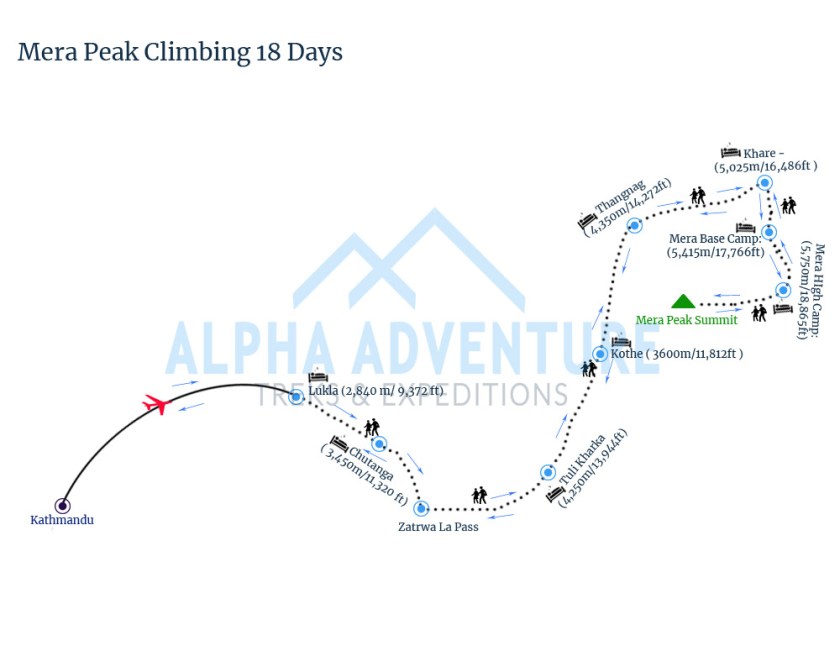
  • Day 01: Arrival and Transfer to hotel
  • Day 02: Fly to Lukla [2,800m/9,186 ft] & trek to Chutanga – Altitude: Chutanga: 3,450m/11,320 ft. | Flight: 35 min | Trek: 3/4 hrs.
  • Day 03: Trek to Tuli Kharka [4,250m/13,944ft.] via Zatrwa La – Altitude: 4600 m/14720 ft. | Trek: 5/6 hrs.
  • Day 04: Trek to Kothey – Altitude: 3600m/11,812ft. | Trek: 5/6 hrs.
  • Day 05: Trek to Thagnag – Altitude: 4,350m/14,272ft. | Trek: 5/6 hrs.
  • Day 06: Trek to Khare- Altitude: 5,045 meters/16551 feet| 5/6 hours.
  • Day 07: Rest day /acclimatization and Pre-Climbing Training and become familiar with using crampons, Carabiners, figure eight, rope Ice Axe etc.
  • Day 08: Climb to High Camp – Altitude: 5,780/18,958 feet | Trek: 5/6 hours
  • Day 09: Mera Peak- Altitude: 6,461 meters/21,190 feet | summit and back to Khare | Trek: 8/9 hours.
  • Day 10: Reserve Day for Contingency.
  • Day 11: Trek down to Kothe – Altitude: 3600m/11,812ft. | Trek: 4/5 hrs.
  • Day 12: Trek to Tuli Kharka – Altitude: Tuli Kharka: 4,250m/13,944ft. | Trek: 4/5 hrs.
  • Day 13: Trek to Lukla – Altitude: 2,800m/9,186 ft. | Trek: 3/4 hrs.
  • Day 14: Fly back to Kathmandu – Altitude: 1350/4428 ft. | Flight: 30 minutes.
  • Day 15: Departure.

Mera Peak Climbing Departure Dates:

Click To Check the Mera Peak Climbing Departure dates.

Mera Peak Climbing: Training/ Physical Fitness

Excellent physical condition is required to climb Mera Peak; therefore, you should start training months in advance. However, we do advise that you start a good fitness regimen at least six weeks before your trip, one that strengthens both your general stamina and particular leg muscle groups. The greatest advice is to venture out into the hills as frequently as you can because there is no better way to prepare for this kind of excursion than by hiking with a rucksack. This is a nice weight to work with because you probably carry around 10 kilos in your day bag. You must have had a lot of prior trekking experience because it will be a long and difficult walk to Khare (4,950 m/ 16,240 ft) and Mera Peak Base Camp (5,350 m/ 17,552 ft). Since day 14 is the summit day, we have had fantastic acclimatization. You must practice trekking up and down hills for three to six hours while wearing a backpack, preferably outside in the hills. Additionally, you should work up to carrying a sack of 6 to 15 kg (13 to 33 lbs) of weight. To get your body ready for continuous hard work, you should also go on multi-day climbs. At addition to all of this, you should work out in the gym four to five days every week. To be able to trek for days on end, you must develop your strength and endurance.

Contact Us For Mera Peak Climbing Package

Views Seen While Climbing the Mera Peak

The exhilarating flight from Kathmandu to Lukla on the first day of the expedition provides breathtaking aerial views of the Himalayas. The sights only become greater and the mountain closer as you get higher. Throughout the trekking and climbing period, it’s possible to witness Himalayan giants like Everest (8,849 m), Mt. Makalu (8,463 m), Mt. Cho Oyu (8,188 m), Charpate Himal (6,770 m), Mt. Nuptse (7,861 m), Mt. Baruntse (7,162 m), etc. Additionally, you visit the stunning Hinku Valley. Along the climb to Mera Peak, there are vistas of fascinating glaciers, gorges, streams, and waterfalls.

Contact Us For Mera Peak Climbing Package

Mera Peak Climbing Difficulty:

Mera Peak Climbing is a non-technical trek that begins at 6400 meters above sea level and includes numerous acclimatization days and training sessions.

Even so, you’ll need good stamina for the experience because you’ll be walking for 5-7 hours a day in the high Himalayan foothills on consecutive days.

As a result, climbing with a little rucksack on your back requires a lot of effort and endurance. The Mera Peak ascent requires prior fitness, trekking experience, and mental fortitude. You would know a lot about the Himalayas if you have already walked above 3000 meters above sea level.

uld know a lot about the Himalayas if you have already walked above 3000 meters above sea level. You must utilize the climbing equipment correctly when climbing. Don’t be concerned!

Contact Us For Mera Peak Climbing Package

Mera Peak Climbing: Altitude Sickness

There is a concern of altitude sickness wherever there are mountains. Higher elevation areas above 3500 meters may experience this mountain sickness. You may travel to Mera Peak from Kathmandu, at 1400 meters, to its highest peak, at 6,476 meters (Mera Peak). Between these two locations, you will experience daily altitude changes. As a result, anyone who is unaccustomed to high or new altitudes is susceptible to developing acute mountain sickness (AMS) or altitude sickness. And this is one of the trickiest parts of climbing Mera peak.

Contact Us For Mera Peak Climbing Package

Mera Peak Climbing: Accommodation

Unless travelers specifically request tents, they will stay in cozy lodges run by local families during the hike and after ascending Mera Peak. Each lodge has a central gathering space with a stove, but the bedrooms, which have two beds and mattresses, a blanket, and pillows, are not heated. You must have a sleeping bag with you. Most of the lodges have flush systems now, although some still use the iconic “drop” toilets. The lodges typically feature gas-powered showers. We’ll be sleeping in mountain tents, which can accommodate two people each. Bring a high-quality sleeping mat and a four-season sleeping bag as well. To avoid overheating when sleeping further down, you might choose to use a sleeping bag liner inside an open-zipped four-season bag.

Contact Us For Mera Peak Climbing Package

What You Should Know Before Climbing Mera Peak:

  • Carry enough cash to cover your entire trek’s expenses. ATMs are not available on the trails (except Lukla). Credit cards are not accepted in most establishments and tea houses.
  • Have some additional cash on hand in case you want to pick up some mementos along the journey. You might be surprised by the range of local handicrafts offered on the trail.
  • Always double-check what’s included in your vacation package.
  • Compare the prices of several trekking agencies’ trip packages before confirming. This gives you the information you need to make an intelligent choice.
  • Get to know your field crew as much as possible before your trip. You can be sure they’re qualified and licensed this way. You can also begin to become acquainted with them.

Contact Us For Mera Peak Climbing Package

Packing List for Climbing Mera Peak:

Gear and Equipment List:

  • Climbing Boots
  • Crampons
  • Ascender (Jumar)
  • Descender (Figure of Eight Lock)/Super 8
  • Screw Gate/Carabiner/Karabiner
  • Ice Axe
  • Helmet-UIAA Test
  • Harness
  • Trekking Pole
  • Insect Repellent
  • Sleeping Bags
  • Prusik Rope/ Infinity Dry Rope
  • Climbing Rope
  • Survival Blankets
  • Altimeter
  • Oximeter
  • Snow Bar
  • Ice Screw
  • Braking Belay Device
  • U-Lock
  • Oxygen
  • Multi LED Headlamp and Spare Batteries
  • Slings
  • Gloves (insulating)
  • Packs and Bags
  • Durable two Duffle Bags
  • A Day Pack
  • A Small Money Bag
  • Alpine Pack

Clothes:

  • Head: A warm hat that covers your ear, face mask, scarf, hat
  • Upper Body: Shorts (both short and long sleeve) expedition weight down jacket, hard-shell jacket, soft-shell jacket, and lightweight down jacket
  • Lower Body: quick-dry shorts, soft-shell pants, down or synthetic insulated pant, underwear, thermal bottoms, hard-shell pants, light-weight trekking pants
  • Hand: Mittens, lightweight synthetic gloves
  • Foot: mountaineering boots, sandals, liner socks, thick socks, hiking shoes

Miscellaneous:

  • Water bottles
  • Thermos bottle
  • Lip Balm
  • Small alarm clock
  • Hand sanitizer
  • Sun cream
  • Binoculars
  • Camera and spare USB cards
  • Pocket Knife and repair kit
  • Plastic bowl, spoon
  • Coffee mug
  • Spare Batteries for torchlight, camera, and cell phone
  • Power Bank

Medical Supplies:

  • Diamox (For Altitude Sickness)
  • Cough and cold medicine
  • Water purification tablets
  • Anti-diarrhea pill
  • Anti-headache medication
  • Antibiotics for chest and stomach infection

Mera Peak Climbing: Route Overview

This expedition begins by departing from Kathmandu, the capital of Nepal and a historically significant city, for Lukla. After 35 minutes of beautiful air ride from Kathmandu, we will reach Lukla. There are three ways to climb Mera Peak, and each is in its own way challenging or simple. Lukla, Zatr La Pass, Tagnag, Mera Base Camp, High Camp, and Summit are the stops on the first route. The shortest but most challenging route is this one. The second route similarly travels via Lukla, Paiya, Thongnak, Khare, Base Camp, High Camp, and Summit. Compared to the former approach, this one is simpler. As a result, the routes differ and the difficulty level of climbing Mera peak does as well.

Contact Us For Mera Peak Climbing Package

Mera Peak Climbing Route Map:

Mera Peak Climbing Route Map

Mera Peak Climbing FAQs:

How hard is Mera Peak?

Mera Peak is considered one of Nepal’s highest climbing peaks. Except for the last peak of 100m/328ft. with a steep that must be ascended vertically, it is not a tough climb at an extreme altitude of 6,461m (21,190ft.). Unlike other trekking peaks in Nepal, Mera Peak is very easy to reach.

Is Mera Peak technical?

Despite the fact that Mera Peak is at a substantial altitude, the ascent is not difficult or complex. This tour is suitable for people who want to try their hand at Himalayan mountaineering and have a strong spirit of adventure.

Can you see Everest from Mera Peak?

Yes, you can enjoy the view of Everest from Mera peak including other three high peaks i.e Cho Oyu, Makalu, Kanchenjunga, and Lhotse.

Which is the best season for Mera peak climbing?

The best season to climb Mera peak is Spring(March-May) and Autumn (September- November) season.

What should I pack for Mera peak climbing?

Mera Peak is known as a ‘trekking peak,’ however the final lap includes some climbing and demands basic mountaineering skills and equipment. The correct equipment and gear are essential for attempting the Mera Peak climb successfully. For climbing Mera Peak, we recommend the following gear and kits:
• Waterproof Duffel Bag (Provided by Himalayan Glacier)
• 40L Back pack (daypack)
• Shirts and t-shirts
• Set of thermals (tops & bottoms)
• Fleece Jacket
• Shell Rain Jacket
• Down Jacket
• Lightweight hiking trousers
• Waterproof/Windproof pants
• Socks
• Buff
• Sun hat & sun glasses
• Gloves & Mittens
• Hiking boots
• Mountain climbing boots
• Flip flops and slippers
• Sleeping bag
• Water bottles
• Sun cream & lip balm
• Gaiters
• Personal toiletries
• Trekking pole
• Scarf & warm hat

How much mountaineering experience do I need to climb Mera peak?

Mera Peak climbing does not require technical mountaineering experience as long as you are fit and strong enough to walk for several hours on diverse terrains over several days. On the slopes, you may need to hold the ropes, utilize an ice pick, harness, and ice boot. Although the travel to Mera Peak’s base camp is more difficult than that to Island Peak’s, the actual ascent is easier in some ways.

How long does it take to climb Mera peak?

It’s a tall peak at 6476 meters, but the standard route needs little difficult climbing. Our escorted tour lasts 18 days; from the time we arrive in Kathmandu to the time we return home. The total number of trekking and climbing days is 15, with one summit day.

What is the cost of mera peak climbing?

The cost of climbing Mera Peak varies from $2350 to $4600 per person. Different operators’ prices vary depending on a variety of aspects such as the services they provide, the number of days they provide, the routes they offer, the accommodations they provide, and so on.

Is Mera peak dangerous?

Mera summit (6,476 m) is a difficult climb with numerous steps and many ups and downs. Though climbing higher on Mera mountain through the lower realm of death zone 5,500 m/18,044ft is unpredictably dangerous, the death rate is extremely low.

How high is Mera peak?

Mera peak is at an altitude of 6,476 m above sea level.

How do you train for Mera peak?

The Mera Peak Climb needs 6/7 hours of daily walking. You will be walking on rugged and uneven terrain. You’ll need to develop solid core and length strength, as well as endurance, to help with this. Lunges, squats, and step aerobics are excellent exercises to incorporate in your training routine.

Has anyone died (Death Rate) climbing Mera Peak?

Mera summit (6,476 m) is a difficult climb with numerous steps and many ups and downs. Though climbing higher on Mera mountain through the lower realm of death zone 5,500 m/18,044ft is unpredictably dangerous, the death rate is extremely low. Thousands of climbers attempt Mera Peak each year, although fatalities are uncommon.

Can I climb Mera Peak without a guide?

No, you need a guide to ascend Mera Peak. Foreign mountain climbers are not permitted to ascend any mountains alone in Nepal. In Nepal, you must work through a licensed travel agency.

When is the best time to Climb Mera Peak?

This region of Nepal also experiences the four distinct seasons of summer, autumn, spring, and winter. Among all of these, spring (March to May) and fall (September to November) are said to be the best times. The weather is likewise temperate during this time, and the route is also clearer.

Is Mera Peak harder than Island Peak?

The trail has more elevation increase up and down, making the climb to Mera Peak more difficult than the climb to Island Peak. In comparison to the Everest region, the lodges and facilities are relatively rudimentary.

Can a beginner climb Mera Peak?

Mera Peak is a standard high-elevation trekking peak. You don’t need any specialized climbing knowledge of ropes, gear, and ice axe use to reach top 6476M. Individuals with little to no mountaineering experience frequently travel to Mera Peak.

Last Word:

Mera Peak climbing is a terrific and thrilling high-altitude activity. It is the world’s best introduction to Himalayan peak climbing.

On the Mera peak routes in May, you can meet professional mountaineers and summit climbers. It’s lovely to be surrounded by their positive energy.

The cost of any expedition, including climbing Mera Peak, is determined by a variety of factors. You have the option of selecting a travel package that suits your requirements and budget. Some of the variables can be tweaked to match your personal requirements.

Feel Free To Contact Us.